Aha Labs ·
What the pointer adds to “here”
You and a colleague are proofing a catalogue. On the left, there’s room between a nautilus and its caption. On the right, the words “Sea urchin” nearly touch the photograph. She points into the gap on the left. “The spacing here is just right.” Then she points to the right. “Give this one that much room too.” You know which caption to move. Now let her say it again, pointing the other way.
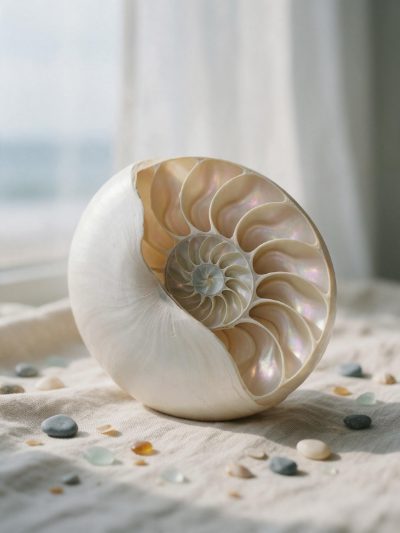 Nautilus
 Sea urchin
Wait for her to take her hand away. Send someone who missed the exchange a screenshot and a transcript. They can see that one caption is tight and the other loose. How could they tell which one she liked? Swapping the gestures changes the edit even when every pixel and every word stays the same.
We built Record in Galta for moments like this. Two people looking at the same page can make a precise request in a few words. What does an interface have to keep for a model to follow it?
One page, edited twice
We put these two photographs on a Galta canvas. The nautilus caption sat 54 pixels below its photograph, the sea urchin caption just 10. Turn on the sound and watch the pointer during the pause between sentences. In both takes it returns to the middle before we press Send.
In the first take the pointer lands on the left first. The model moves “Sea urchin” down by 44 pixels, giving both captions the generous gap. We start the second take from the original layout in a fresh conversation. This time the pointer lands on the right first. The model moves “Nautilus” up by 44 pixels. Both captions now sit close to their photographs.
We used one recording of Fish Audio’s Hannah voice as the microphone input for both takes. GPT-6-Astra received the same spoken request through Record each time, with no additional written instructions. The saved canvases tell us which caption actually moved. You can inspect the pointer samples, transcripts, model replies and coordinates in the records of both takes.
Why “here” is enough
In a study by psychologist Adrian Bangerter, two people looked at the same array of twenty faces. One knew which face to find and had to help the other identify it. Bangerter varied how far away the faces were and whether the listener could see the speaker point. As the faces came closer, speakers used their hands more. When they could point, they spent fewer words describing where to look. [1]
Look again at what our colleague pointed to. Click the photograph and you select a photograph. Click the caption and you select a line of type. Her finger lands in the empty space between them. Once your eye follows her hand, “that much room” has a measure. She never needs the term “caption spacing”.
Put that there
In this 1979 MIT recording, Chris Schmandt sits in front of a wall-sized display and directs the shapes on it with one hand. Watch his hand when he names the thing to move, then watch it again when he gives the destination.
Richard Bolt’s paper the following year explains an elegant feature of the system. In a request to create a square “there”, the word tells the computer when to read the pointing coordinates. The command tells it what to do with them. Our catalogue asks something subtler. The first gap is an example to preserve. The second is the one to change. Either set of coordinates could play either part. [2]
Speech and gesture can also arrive at different times. Sharon Oviatt and colleagues studied people giving spoken directions while using a pen on a map. In some exchanges the pen supplied a location before the person spoke. Move your pointer under the urchin, hold it still and say “here”. A system looking for mouse movement just as you speak would miss your point precisely because your hand was steady. [3]
What can the model know?
In SeeClick’s ScreenSpot evaluation, a model gets a screenshot and an instruction. Its click must land inside the intended control. The researchers showed that training specifically for this task improved performance. Now grant the model perfect vision on our catalogue page. It can locate both captions and measure both gaps to the pixel. It still needs to know which gap our colleague pointed to first. [4]
Suppose a fair coin determines which side she points to first. Give the model the same screenshot and transcript either way and ask it to choose a caption to move. Call its probability of choosing the left caption p. Half the time the left caption is the right choice. On the other half it must choose the right caption. Its expected accuracy is
The 50% limit follows from the evidence we withheld. A model with excellent typographic taste might always loosen the cramped side and get exactly half right. TempCompass uses a related test in video. Clips can contain the same objects while differing in the direction of motion or the order of events. Those differences require evidence that the contents of a still image cannot supply. [5]
In Galta you can point and speak while Record is running. Stop leaves a local draft you can replay. Send submits the audio for transcription. The agent receives the transcript, sampled canvas views and timed pointer locations, and it can inspect the canvas itself. The surrounding sentence gives each gesture its role. Turning the first point into an automatic selection would make the best-spaced caption on this page a target for editing.
Putting a word back on the canvas clock
A person can cross the page in the silence between two sentences. Galta shortens quiet intervals before sending the audio for transcription. The pointer keeps time against the original recording. Remove two seconds of silence and a word stamped 1.40 seconds on the speech track can belong at 3.40 seconds on the canvas.
The pointer starts on the left and moves right at two seconds. Hatching marks the silence cut before transcription. The red strokes mark the word “here”.
Recording 3.40–3.70 s · The pointer is on the right.
With the default two-second pause, the second piece of speech starts at 3.20 seconds in the recording and 1.20 seconds on the shortened track. The word begins 0.20 seconds into that piece, so its original time is 3.20 + (1.40 − 1.20) = 3.40 seconds. For a retained piece starting at a in the original and c on the shortened track, a timestamp u within the piece maps back to
Now check the box to let the word straddle the cut. At the default setting, the interval 1.10–1.40 seconds maps to two pieces, 1.10–1.20 and 3.20–3.40. Taking the midpoint between their outer ends would put the speaker in the middle of the silence. Galta keeps both pieces. The figure uses a prescribed gesture and the same time conversion as the public code. Errors in a word or its timing can still enter during transcription.
We checked the pointer separately in Galta 0.1.6. Two phrases began at one and four seconds. The pointer settled half a second before each phrase and returned to x = 500 at the end of both trials. Pointing left first attached x = 200 then 800 to the phrases. Pointing right first gave 800 then 200. The final frame was identical. [6]
Which points on a stroke should survive?
Trace a shallow bend from left to right in one second. Galta 0.1.6 keeps the endpoints and the last sample at or before the halfway mark. It joins those points, measures how far the other samples lie from that line, and scales the distance by the canvas zoom.
At 1×, three points survive. The bend is 6 screen pixels from the line, below the 8-pixel threshold. At 2×, all four survive. At twice the zoom the same bend measures 12 screen pixels, enough to keep it.
Both plots use the same scale. The dashed line traces the input and the solid line traces what the model receives. The samples are (0, 0), (40, 0), (70, 6) and (100, 0) at 0, 0.5, 0.7 and 1 second. The public code adds the point with the greatest error until all remaining points fall within the threshold or the stroke reaches its budget of 16 points. A complex stroke can exhaust that budget while a larger error remains.
Run these three examples with Bun and the public 0.1.6 source. They check the evidence delivered to the model and require no inference.
A test that gave us too much confidence
In one development build, the recognized Chinese arrived in fragments. The complete sentence had disappeared from the material sent to the agent. Our test still passed. When we read the test prompt again, there was the missing sentence. We had supplied it ourselves.
On November 4 we compared two development versions of the gesture record. We gave the same Codex model descriptions of shapes on crowded canvases and text records of simulated gestures with imprecise pointing. We knew in advance which shape each “this” referred to. Each row below compares the two versions on one task.
| Task | Earlier format | Revised format |
|---|---|---|
| Point to one shape (correct) | 33 / 48 | 41 / 48 |
| Circle a group (set F1) | 0.88 | 0.69 |
Of the 48 pointing decisions, 11 went from wrong to right and three went from right to wrong, a net gain of (11 − 3) / 48 ≈ 16.7 percentage points. Group selection went the other way. The model could miss an intended shape or sweep in a neighbour. For predicted set P and intended set G, F1 = 2|P ∩ G| / (|P| + |G|). If the model selects four shapes, two of which belong to a target group of three, it scores 4/7, about 0.57.
Each round had only eight gesture examples. The model worked from simulated gestures and transcripts, without pictures or a live speaker. Both formats included timing, and several details changed at once. The group result exposed a regression. Whether Record helps a person finish an edit sooner remains an open question.
We would test that in two steps. First, give the same model three versions of the catalogue task in fresh conversations. One includes the screenshot and the words. A second adds both pointer locations without their order. A third gives the timing of each point relative to speech. A pair counts as solved only if both intended captions move and both references stay put. Then have people edit comparable new layouts by typing or using Record, alternating which comes first. Start the clock when they get the brief and stop it when they accept the edit. Include time spent waiting, clarifying and repairing. The film shows the full-input condition on one layout. Those comparisons remain to be run.
Room to say “wait”
Herbert Clark and Meredyth Krych asked pairs of people to build Lego models. One person gave directions and the other did the building. When directors could see the builder’s hands, they revised instructions mid-sentence. Hiding the work slowed the pairs down. Playing recorded instructions led to more mistakes. Across a table, the first reach for the wrong brick gives you time to say “wait, the one beside it”. [7]
With a recorded request, that moment passes before the listener can respond. If the pointer wavers between two captions, “Which gap should I match?” is a good question. If the gesture was clear and I still have to type “the label under the sea urchin on the right”, the interface has given me my work back.
What we want is the ordinary ending to the conversation at the desk. Your colleague takes her hand away. You look down. There’s room under the urchin now. The nautilus is just as she left it.
References
- Adrian Bangerter (2004). Using Pointing and Describing to Achieve Joint Focus of Attention in Dialogue
- Richard A. Bolt (1980). “Put-That-There”: Voice and Gesture at the Graphics Interface
- Sharon Oviatt, Antonella DeAngeli & Karen Kuhn (1997). Integration and Synchronization of Input Modes during Multimodal Human-Computer Interaction
- Kanzhi Cheng et al. (2024). SeeClick: Harnessing GUI Grounding for Advanced Visual GUI Agents
- Yuanxin Liu et al. (2024). TempCompass: Do Video LLMs Really Understand Videos?
- Galta 0.1.6. recordingTimeline.ts
- Herbert H. Clark & Meredyth A. Krych (2004). Speaking while Monitoring Addressees for Understanding